
How Much Complexity Can One Theory Take?
A new edition of an essay about the creation of cognitive load theory

I wrote the first version of this essay back in 2016. What I’m sharing today is a substantially revised and slimmed down version of that original. It wasn’t easy to bring over the references and bibliography, but you can still check them out here.
PS. Paul Bruno helped me out back in 2016 by giving this a good, skeptical read. I recall feeling guilty about not giving him enough public gratitude. Sorry about that. Thanks for your help, Paul!
PPS. I have an extraordinarily short story titled “Blink and you’ll miss it” up at the awesome journal HAD. It’s so short, it’s barely a story. But I think it’s cool. It pops into my head now and then, and I’m glad when it does. Please go check it out.
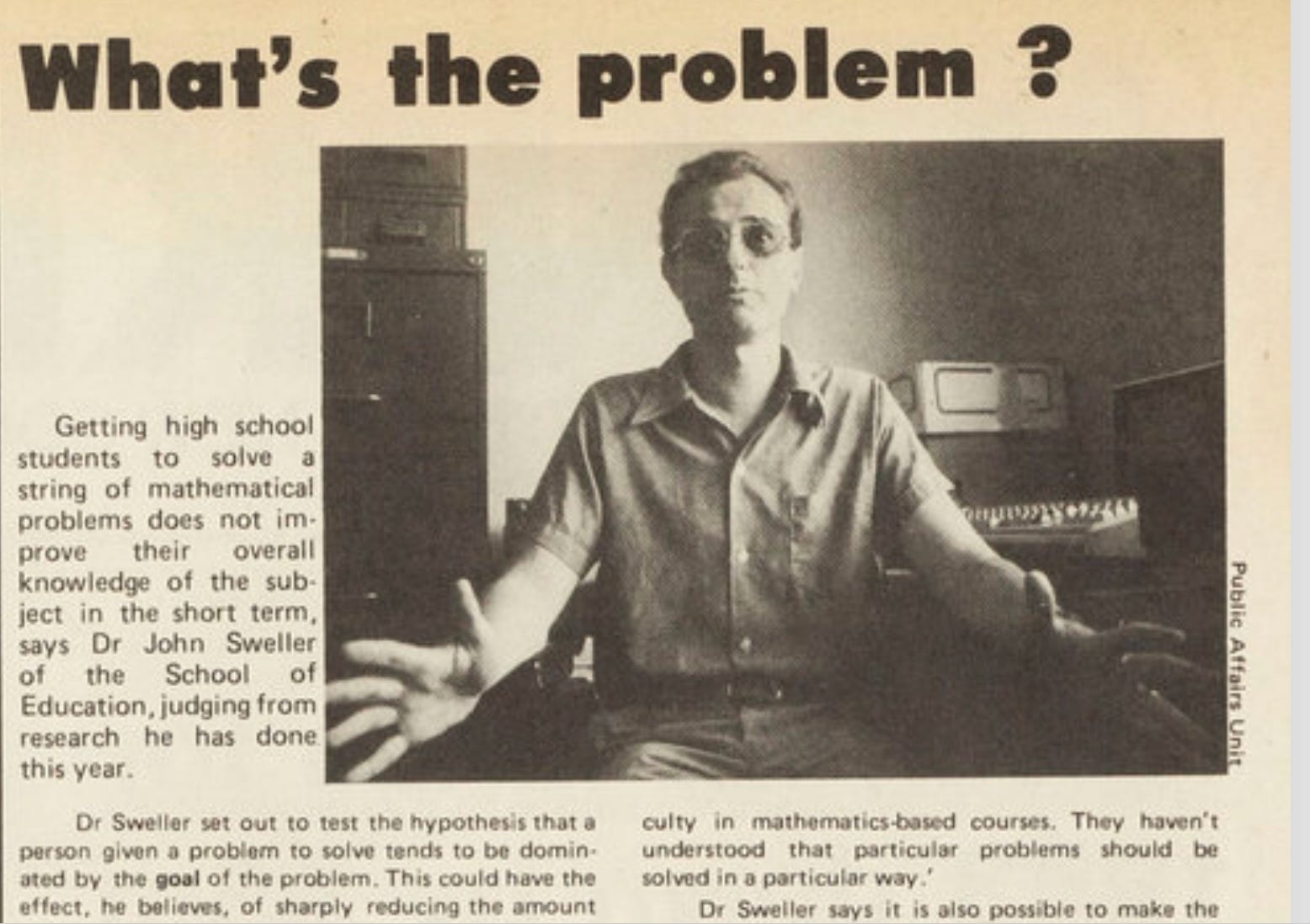
In 1972, John Sweller needed a change. After earning his PhD at University of Adelaide, he’d accepted a position as a psychology lecturer in Launceston. But Launceston was a small town and far from Adelaide where he’d been raised. Sweller’s family were Polish Jews. They’d survived the Holocaust and come to Australia only after the war, where Sweller’s aunt had already settled. He missed them.
Beyond the personal, Sweller’s research—which initially focused on learning in rats—was moving slowly in Launceston. So at the end of the year, Sweller left for UNSW’s Sydney campus, where he reinvented himself as a researcher in the emerging field of human problem solving.
In an early experiment, Sweller gave undergraduates a number puzzle:
“I am going to give you one or more problems to solve. You will be given an initial number and asked to transform it into a final number by multiplying 3 and/or subtracting 69 as many times as is required.”
The game, however, was rigged. The numbers were carefully chosen so initial numbers could be transformed into their targets by alternating between multiplication and subtraction. Could the players of this game discover this winning strategy all on their own?
Sweller found that most participants never discovered this rule. Instead, they used a different technique to attack the puzzle—at each turn they performed whichever move would make their number closer to the goal.
Suppose a participant was tasked with turning 54 into 210. Here’s a typical approach:
54 is less than 210, so multiply to get closer to 210.
That gives 162. Too small. So multiply again.
Oh no! That gives 486, too large! Subtract.
Subtract and subtract again! until you are below 210!
Now continue this process—called “means-ends search”—until the puzzle is solved. It will take many steps. Meanwhile, alternating between multiplication and subtraction solves the puzzle in four moves.
Sweller hypothesized that means-ends search is not just clunky, but that it actively harms one’s ability to discover a better approach. If you’re always comparing your current result to the number you want, you’re completely ignoring all of your prior moves. This ignorance disrupts any chance that of noticing generally reliable patterns. The means-ends search is not only slow, but it directs all of one’s attention away from what matters for learning.
To Sweller, these results underscored the huge difference between solving a problem and learning something useful from the experience:
“After an enormous amount of problem-solving practice, subjects could remain oblivious of a simple solution rule.”
Sweller next designed experiments to observe this dynamic in school algebra. He saw the same thing: beginners chose means-end strategies that direct attention away from the sorts of global observations that might lead to powerful learning.
The moral: If teachers want to foster expertise, they need to short-circuit these means-end search strategies. He started looking for tasks that would direct attention in better ways.
Goal-Free Problems
Sweller’s first idea for avoiding means-end search was what he called “goal-free problems.”
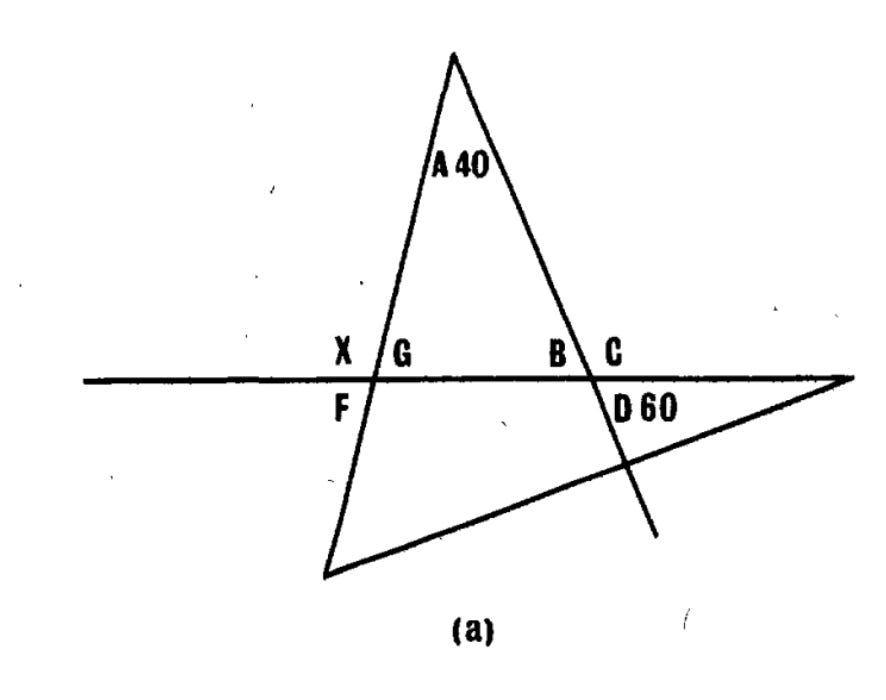
Despite the name, Sweller’s goal-free problems do have goals, but those goals are nonspecific (“find as many angles as you can”) rather than specific (“find angle x”).
When Sweller asked participants to find values of specific angles in a diagram, novices used means-end search—they tended to work backwards from the “goal” angle, constantly checking their distance from the goal angle. But this funnelled attention unproductively towards angles directly nearest the target. As in the number puzzle experiments, even when participants successfully solved these goal-specific problems, the participants learned little from it.
But when Sweller asked participants to find as many angles as they could, things changed. Freed from a single, clear goal to fixate on, participants’ attention wandered across the entire diagram. They looked for parts they could directly solve. Progress came more freely. Far more often, they noticed patterns in their past moves. This freedom to think broadly is exactly what is needed for discovering useful, expert-like shortcuts.
These results were a landmark for Sweller, but he was interested in going further. Goal-free problems were still problems, albeit unconventional ones. What if problems were totally unnecessary for learning?
Worked Examples
Worked examples are not problems—they are problems accompanied with solutions. Goal-free problems made the search more productive. But could you eliminate the search entirely?
In another series of experiments, Sweller carefully tested this idea. His results supported the hypothesis: the quality of learning was the same (or better) whe students learned via analyzing worked examples. The major difference was time—problem solving took a lot more of it.
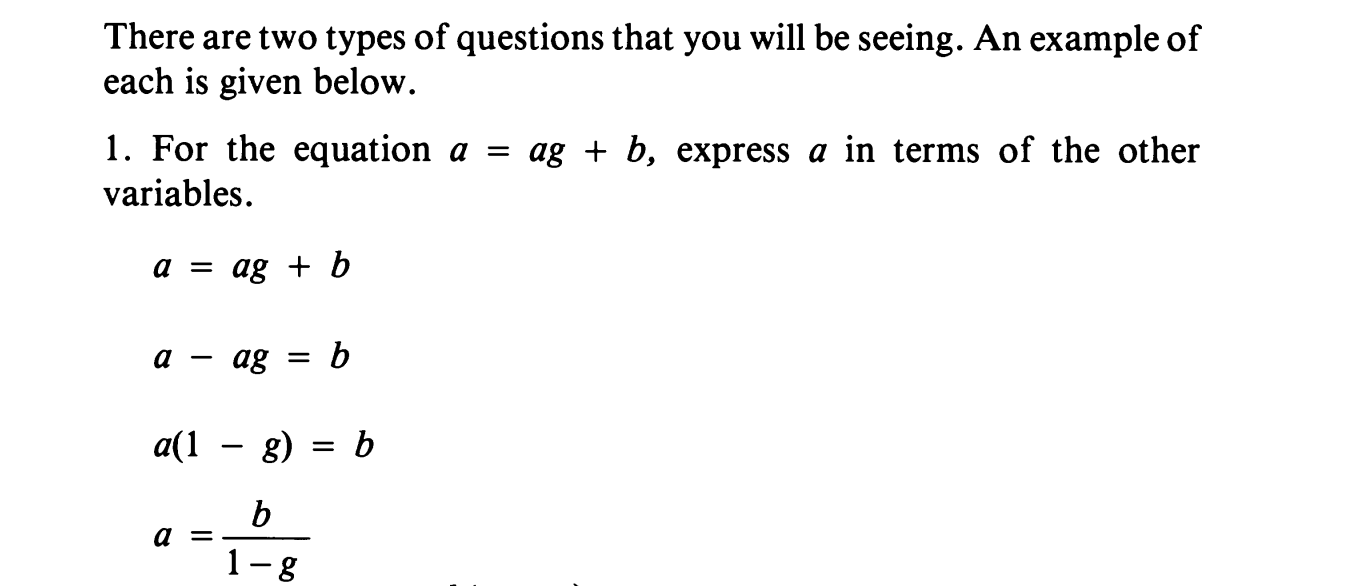
With goal-free problems and worked examples in hand, Sweller began to take his results to the math education world. A 1989 piece in the Journal for Research in Mathematics Education asked, “Should Problem Solving Be Used as a Learning Device in Mathematics?” The answer was, “no”:
Students may learn more by solving goal-free problems or by studying their problem solutions than by solving the problems in the first place. This of course begs the question: Why solve the problem in the first instance?
Sweller never defines “problem” in his 1989 paper, but he does describe the sort of mathematics instruction he sees as ineffective:
The conventional mode of mathematics teaching is stereotyped. New material is presented and one or two worked examples using the new materials are demonstrated, followed by a reasonably large number of problems or exercises…Solving many conventional problems may not be the best way of acquiring this knowledge.
On the other side of an ocean, around the very same time, problem solving advocates like Alan Schoenfeld were voicing similar concerns about the status quo. “Most textbooks present "problems" that can be solved without thinking about the underlying mathematics,” he wrote. Instead students succeed in class “by blindly applying the procedures that have just been studied.”
The critique was shared, but whereas Schoenfeld wanted bigger, more significant problems that would give students a taste of a mathematician’s work, Sweller was thinking about a smoother, more efficient route for learning mathematical skills.
Inventing Cognitive Load Theory
Up until this point, the leading actor in Sweller’s theory was attention. But starting in 1988, attention would disappear from Sweller’s work. Taking its place was cognitive load, a concept which Sweller increasingly used to explain his experimental results. This shift marked the creation of Cognitive Load Theory.
In the mid-1970s, Baddeley and Hitch, a pair of psychology researchers, argued (contra the most dominant current theories) for the existence of a memory component that was severely limited but essential for long-term memory formation. They called it “working memory.”
We’ve all experienced the frustration of a teacher who says too much, too quickly. All teaching imposes a cognitive load on us that saps our working memory resources. Too high of a cognitive load, and learning is impossible.
Go back to the number puzzle. The means-end search requires holding a lot of information in your head and then doing stuff with it:
the rules of the puzzle (subtract by 69 or multiply by 3)
the goal number (e.g. 210)
the current number (54)
comparing the current number to the goal (smaller)
That’s a lot of information—there’s hardly room for anything else! The cognitive load of that strategy was too high, and so learning (which itself requires cognitive resources) could not occur.
I’ve always been interested in the shift away from attention. (As you can tell, I’m fond of some of the older, attentional explanations.) Sweller emphasized that it’s possible to explain his results using both attention and cognitive load:
“Rather than using cognitive processing capacity terms, we could just as easily describe these circumstances in attentional terms. Indeed, for practical purposes, under some conditions it may not be useful to distinguish between the two processes.”
So why shift terms at all? It might have to do with interest in computational models of the mind. In 1984, Sweller spent several months in Pittsburgh trying to show how his results flow from cognitive models of learning. His program kept track of the number of statements being held working memory. Maybe he felt that sort of thing would be useful for future studies.
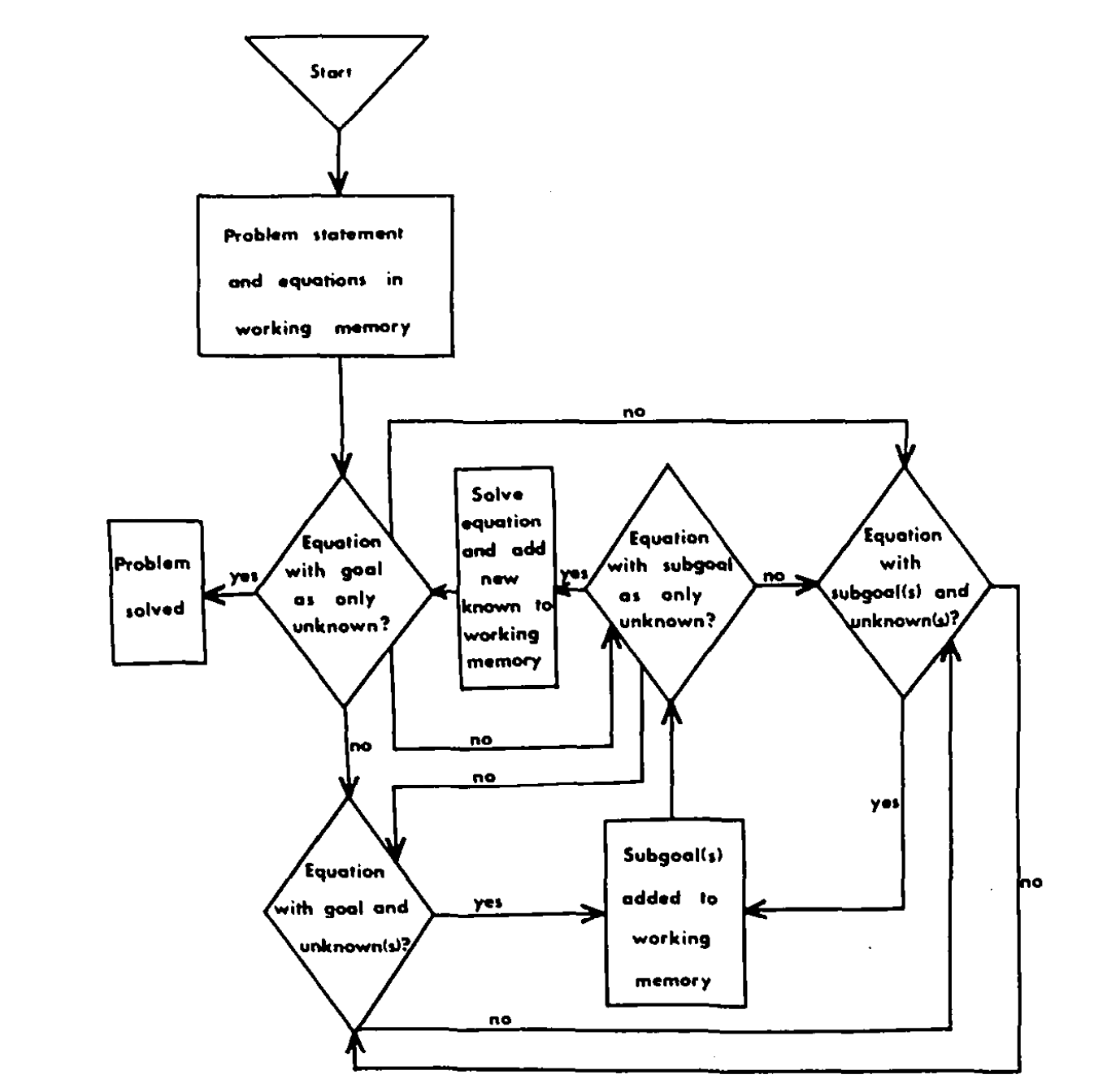
Sweller now had a foundation on which to build, and new results emerged.
Textbooks often place geometric diagrams and blurbs on different parts of the page. Better to weave the text into the diagrams, Sweller found, so details didn’t have to be remembered while the eye darted around. (They called the measurable impact on learning the “split-attention effect.”) In the new parlance of CLT, poor design imposed extraneous load on students. (It was “extraneous” because it was avoidable, rather than “intrinsic” to the material.)
By Sweller’s own account, the research community did not line up behind CLT. “The research on worked examples was treated either with hostility or more commonly, ignored,” he wrote. In 1991, psychologist Susan Goldman asked whether “cognitive load theory [provides] an adequate general theory of learning?”
Sweller’s response was telling. While he quibbled with many of Goldman’s claims, one major difference became clear: Sweller was an theoretical instrumentalist, hardly after a general theory of learning at all:
“A better understanding of various phenomena is probably the most common justification for a theory,” he wrote. However, “there can be only one ultimate goal…the generation of new, useful instructional techniques.”
The sole purpose of CLT, for Sweller, was inventing new instructional techniques—a theory’s job is inspire new, useful ideas. Over the coming years, Sweller would continue working in this vein. But, inspired by the theory’s successes, a new crop of researchers would push the theory in new directions that would test CLT’s limits.
Tackling Complex Learning
In a 2023 farewell lecture (shortly before his death at age 64), Jeroen van Merriënboer described his earliest work. He’d been teaching beginner computer programming, where students often failed to compose working programs. He felt there was a solution—what he’d later call completion tasks:
“I began to observe what professional computer programmers do. They mainly do things like debug existing programs, make changes to existing programs by adding new procedures, and sometimes write programs from scratch. I used these professional tasks as a basis for designing learning tasks in a new course. In this new course, students were confronted with simple but meaningful computer programs right from the start. They were invited to figure out what the programs could and could not do, to make changes to the programs, or to add new routines to them. The commands that needed to be used in the program were not explained by the teacher beforehand, but only once they were needed to understand the working of the program; that is, they were presented just-in-time.”
van Merriënboer found that these completion tasks were often very effective, more so than asking students to study and imitate examples of correct programming. Why? Part of the reason was motivation:
“...students will often skip over the examples, not study them at all, or only start searching for examples that fit in with their solution when they experience serious difficulties in solving a programming problem. ... [In completion problems] students are required to study the examples carefully because there is a direct, natural bond between examples and practice.”
Studying worked examples could help students learn to write software, but they had to be properly motivated to do so.
In another experiment, adding another wrinkle, van Merriënboer tasked his students with studying a series of worked examples. But for some students, van Merriënboer increased cognitive load by increasing the variability of their worked examples. (For everyone else the worked examples were basically identical with different numbers.) The high-variability condition was significantly harder for students—it took them longer. Also students reported experiencing a higher degree of mental effort. Despite these difficulties, students ended up outperforming their low-variability counterparts in a follow-up test.
Sweller had shown that bad textbook design could increase cognitive load while impairing learning. But this cognitive load, though not intrinsic to the content, seemed to be good for learning.
Neither the motivation nor the high-variability results contradicted Sweller’s results, but it was certainly a new direction, as Sweller and van Merriënboer conceded in a joint paper several years later:
“Until now, cognitive load theory research almost exclusively has studied instructional designs intended to decrease extraneous cognitive load. Recently, some studies have been conducted in which [cognitive load] was increased for processes considered to be directly relevant to schema construction.”
van Merriënboer and Sweller, for all that they shared, were simply interested in different kinds of learning. Sweller’s work involved “basic” skills. He liked designing experiments where students acquired individual procedures in a laboratory setting, which could then be applied to teach high school math and science. As van Merriënboer’s doctoral work shows, he came from a world of “complex” learning, where the skills have more moving parts. He started with computer programming—later he’d shift to designing materials for medical education.
CLT had been created out of Sweller’s work. It’s unsurprising that Sweller hadn’t introduced motivation or high-variability conditions, as his experiments used volunteers learning individual skills. But van Merriënboer was working with students learning complex skills in a classroom. His desire to add wrinkles to CLT is understandable.
In 1996, Sweller spent a sabbatical with van Merriënboer in the Netherlands. The two tried, somewhat unsuccessfully, to bring their approaches together. In a later reflection on this collaboration, van Merriënboer (characteristically) suggested that their work was difficult, but in a good way:
“John and I encountered many problems in bringing cognitive load theory and models for complex learning together, because they are rooted in very different traditions. But problems are there to be solved and we always have a lot of fun doing so.”
In their joint work, they introduced a new type of cognitive load, which they called germane load. Germane load was—like the effort introduced by completion tasks or high-variability—an additional mental burden that benefited learning. Following van Merriënboer’s lead, the goal for CLT was no longer merely to reduce extraneous load, but to then use that newly available mental capacity to good effect. “Learners’ attention must be withdrawn from processes not relevant to learning and directed toward processes that are relevant to learning,” they wrote.
Echoing van Merriënboer’s earlier work, their joint paper points out the benefits completion tasks can have over worked examples:
A lack of training with genuine problem-solving tasks may have negative effects on learners’ motivation. A heavy use of worked examples can provide learners with stereotyped solution patterns that may inhibit the generation of new, creative solutions to problems…For this reason, goal-free problems and completion problems…may offer a good alternative to an excessive use of worked examples.
Before this collaboration, Sweller had rarely written about student motivation. Neither had he concerned himself with long-term learning issues resulting from “stereotyped” solution patterns. CLT was moving into complex learning, and ever-so-subtly changing in the process.
Expertise Reversal
At the same time that CLT was moving into more complex learning, changes were happening within CLT’s core. Slava Kalyuga, a student-turned-colleague of Sweller’s, collaborated on a series of papers introduced a minor revolution into CLT, one that made room for conventional problem solving in the learning process.
Kalyuga and Sweller showed that the original results of CLT reflected only the learning needs of novices, who were new to the problem. Worked examples worked great, but once you knew a bit they were no longer as helpful. At that point you were an “expert,” and were measurably better off solving a problem.
Kalyuga and Sweller offered a characteristically elegant explanation for this reversal. The problem with problem solving (for novices) is it jump starts the means-ends search. But, once they know enough about a topic, students won’t launch into a laborious means-end search—they’ll try to apply the techniques they’ve learned. They don’t need worked examples; they need practice using the techniques they already studied. Kalyuga and Sweller called this the “expertise reversal effect.”
In 1988, Sweller had suggested that problem solving be practically eliminated from the mathematics curriculum. A decade later, his position had evolved significantly. Problem solving was unproductive for novices, not for students who have already studied the relevant procedures (“experts”). He’d also found room in his theory for productive challenges that increased mental effort in a good way. Thanks to van Merrienboer and Kalyuga, the menu of teaching methods was now larger than originally suggested. Challenging tasks and even conventional problems were back on the table, if used properly.
In 2005, van Merriënboer and Sweller collaborated again. In “CLT and Complex Learning: Recent Developments and Future Directions,” the two scholars listed new and promising research directions for the theory, including the design of materials that motivate students to put in efforts that “evoke” germane cognitive load.
There was no hint in this fundamentally optimistic piece that just five years later Sweller would renounce germane cognitive load and declare motivation outside of the scope of CLT. But how do we decide what’s in or outside the scope of a theory? And what are those decisions based on? Just how much complexity should a theory of learning be allowed to entertain?
A Theory of Everything?
In 2012, John Sweller was interviewed by Derek Muller of Veritasium. He asked Sweller to speak to the role of motivation within CLT. Sweller asserted the importance of motivation for learning, but placed its study outside the scope of his theory:
“One of the issues I faced with Cognitive Load Theory is that there at least some people out there who would like to make Cognitive Load Theory a theory of everything. It isn’t. […] It has nothing to say about important motivational factors…It’s not part of CLT.”
This interview was part of a broader shift in his thinking. In 2010, Sweller published a piece that effectively eliminated germane load from CLT. Why the shift? In a short comment online, Sweller explained:
“Here is a brief history of germane cognitive load. The concept was introduced into CLT to indicate that we can devise instructional procedures that increase cognitive load by increasing what students learn. The problem was that the research literature immediately filled up with articles introducing new instructional procedures that worked and so were claimed to be due to germane cognitive load. That meant that all experimental results could be explained by CLT rendering the theory unfalsifiable. The simple solution that I use now is to never explain a result as being due to factors unrelated to working memory.”
Just five years before, Sweller had co-authored a piece that concluded with a rousing call for researchers to investigate motivation and germane load within the framework of CLT. Now these factors had no home within the theory.
But during the five years between his collaboration with van Merriënboer and his elimination of germane load, Sweller saw confusion creep into the CLT literature. In a piece subtitled “The Good, The Bad and The Ugly,” Sweller collaborators Kirschner, Ayres and Chandler decried the direction many CLT researchers were taking. Too many were using sloppy techniques to subjectively measure various types of cognitive load. Other researchers were offering speculative post-hoc explanations to make sense of their results. There was a need to defend and clarify boundaries. Sweller reasoned that motivation and germane load weren’t worth the trouble, even if they were an inevitable part of real-world, complex learning.
Productive Failure?
Sweller had erected clear boundaries around CLT. Now that a world of learning outside of CLT had been established, instructional techniques that had failed within CLT might be posited to thrive in more complex settings.
Re-enter Slava Kalyuga. In 2011 Kalyuga had called for the elimination of germane load. First, because it was unnecessary. It was also a distraction.
“CLT was originally developed to suggest means for reducing extraneous cognitive load in learning,” he wrote. Allowing germane load wasn’t wrong as much as unproductive—it would “potentially devalue CLT as a specific and constructive instructional theory.”
Then, in 2015, Kalyuga called for a further restriction of CLT’s boundaries. The issue was a series of papers from problem-solving advocates that reported evidence that problem solving techniques could be benefitial—things like “productive failure,” “invention,” and “preparation for future learning.” While subtly different from each other, each of these studies clearly contradicted the anti-means-end perspective of CLT.
Kalyuga’s solution looked a great deal like his solution to the threat of germane load: withdrawal. “The boundaries of cognitive load theory need to be narrowed down,” he wrote.
CLT, Kalyuga argued, was about committing a particular procedure to memory. But there’s more to learning than just remembering procedures, like understanding the meaning of the problem itself. Consider an algebraic equation such as 2x = 10:
Asking novice learners to solve the equation would most likely trigger applying a trial-and-error procedure by randomly testing different values for x, which would effectively demonstrate the dependencies between the elements of the equation and relations between both sides of it—exactly what is required to understand the nature of this problem situation and missing knowledge.
Means-end search or trial-and-error might not help you learn the technique, but they’d still be helpful for learning. They’re just helpful in a way that goes beyond what CLT had traditionally considered.
Sweller, for his part, was unswayed by the contradictory research that so impressed Kalyuga. (In a pointed back-and-forth with one of these research teams, Sweller suggests that their work breaks the “vary-one-thing-at-a-time rule essential to all randomized, controlled experiments.”) Which leaves us with slightly (but significantly) different visions of the same learning theory.
How Much Complexity Can One Theory Take?
In his story “On Exactitude in Science,” Borges imagined an Empire so driven to add detail to their maps that their cartographers created a “Map of the Empire whose size was that of the Empire.” The map was, of course, completely useless.
There’s only so much complexity you can include in a scientific theory. The whole point of a theory (or a map) is to eliminate and simplify. Science (especially learning science) is not about finding theory, fully formed, out in the world. It’s much more like modeling, crafting. It’s the hard work of “just enough.”
This can, at times, lead to a certain amount of talking past each other.
Roxana Moreno, a researcher, has critiqued CLT for ignoring the way emotions and motivation can impact how much working memory is available. “CLT is remarkably silent about the relation among load, affect, and motivation,” she writes. “Cognitive load research often ignores the existence of earlier research and theories that may better account for the findings than CLT.” This echoes things I’ve heard mathematics education researchers say over the years.
But none of this would bother Sweller. For him, educational theory has “one ultimate goal: the generation of new, useful instructional techniques. All other functions of a theory are surely subsidiary to this ultimate function.” The job of theory isn’t to explain every result or subsume known factors. The point, for him, is finding useful techniques. “Look at the effects we’ve found,” you can imagine him saying in response. “The proof is in the pudding. So feh.”
If Sweller has constrained the boundaries of CLT, avoiding modifications for the sake of complex learning or broader educational goals, it’s only to put his theory in a position to continue being useful.
But, of course, reasonable people can disagree on what’s useful, and that impacts the shape a theory takes.
Social scientists have sometimes looked towards the physical sciences for a picture of how their science should, ideally, develop. (I’ve heard this derisively called “physics envy.”) In physics, there’s an idea that theories march in a strict procession. First you get Aristotle. Next Newton. Now we’re up to Einstein, or whatever, and so on down the line.
But is this how the science of learning should work? “Theories in psychology are not like theories in, say, physics,” writes Dylan Wiliam.
“In psychology, the tendency is for each new theory to be very good at explaining what previous theories did not, but generally not so good at explaining what the previous theories explained well...each new theory does not replace the preceding theories but rather complements them.”
This seems right to me. Unlike physics, in teaching and learning we will always have an ecology of theories that are complementary, each appropriate for their chosen perspective and purpose. This is true within CLT. It’s also might be true of learning research more broadly, where CLT is just a single possible perspective among many. The degree of complexity a researcher chooses to take on is perhaps just that—a human choice.
You may be aware that along with Sweller, Slava Kalyuga was one of my PhD supervisors. I remember visiting UNSW around, say, 2016. Jan Plass was visiting from New York. Slava was beaming and excited as if the prodigal son had returned and I sat in on Plass’s talk. Earlier in his career, Plass researched cognitive load theory, but the talk he gave that day was on his new research into computer games-based learning. I found it odd and unimpressive, but Slava was enthused. At the end, I asked Plass how he could reconcile all the extraneous load in these games with cognitive load theory. His response was withering. None of that mattered if kids aren’t motivated to learn. The kids these games were for were doing no maths, so doing some was an improvement. I’ve not heard much about these games since then.
I have not read Rethinking Cognitive Load Theory so it might be brilliant. It might also be full of extraneous information. I’m not motivated enough to find out.
I enjoyed reading this so much! Thank you.