
A Math Memorization Routine
I now hate flashcards.

Hey, everyone! First up: I have a poem in Bruiser called “Trash Man.” It’s about a trashcan man. Also, I have a story in Does It Have Pockets? called “Tandem Jump.” It’s about a grumpy guy whose tandem skydiving instructor won’t stop talking during the jump. I like both of these things and I hope you can be tempted to read them!
Now, back to math.
Something you learn after a few years inside schools is a lot of educational “controversies” aren’t actually that controversial. The “math wars” or “reading wars” are real, but those battles are mostly waged in universities or online. Inside, even across schools, there’s not “war” as much as a mushy, often unsatisfying, consensus.
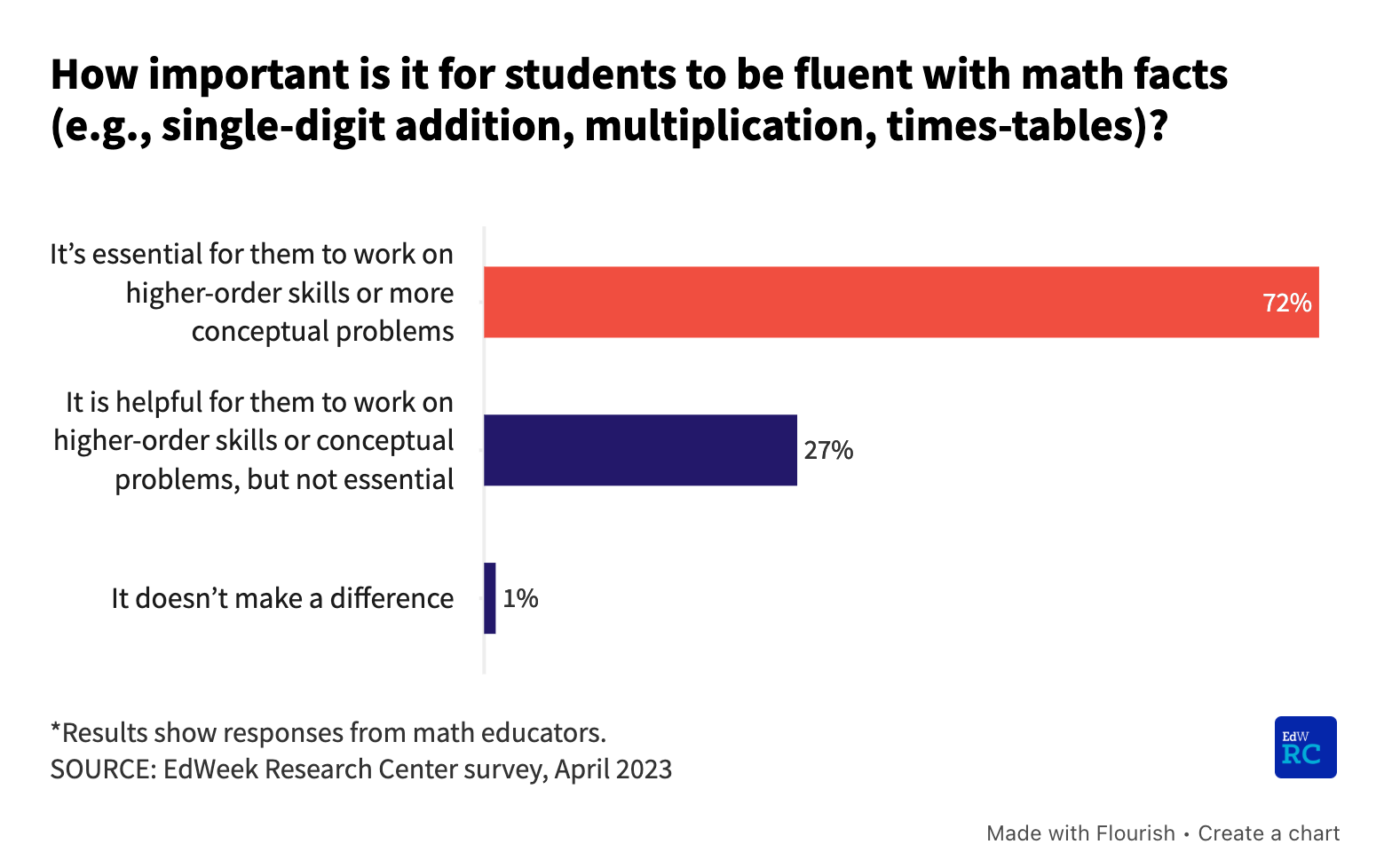
A good example of this is math fact memorization. There are endless articles explaining why math fact memorization is important. But when Education Week surveyed 300 teachers about math fact fluency, 72% said it was “essential” and 27% said it was “helpful” for future mathematical work—only 1% said it didn’t make a difference at all.
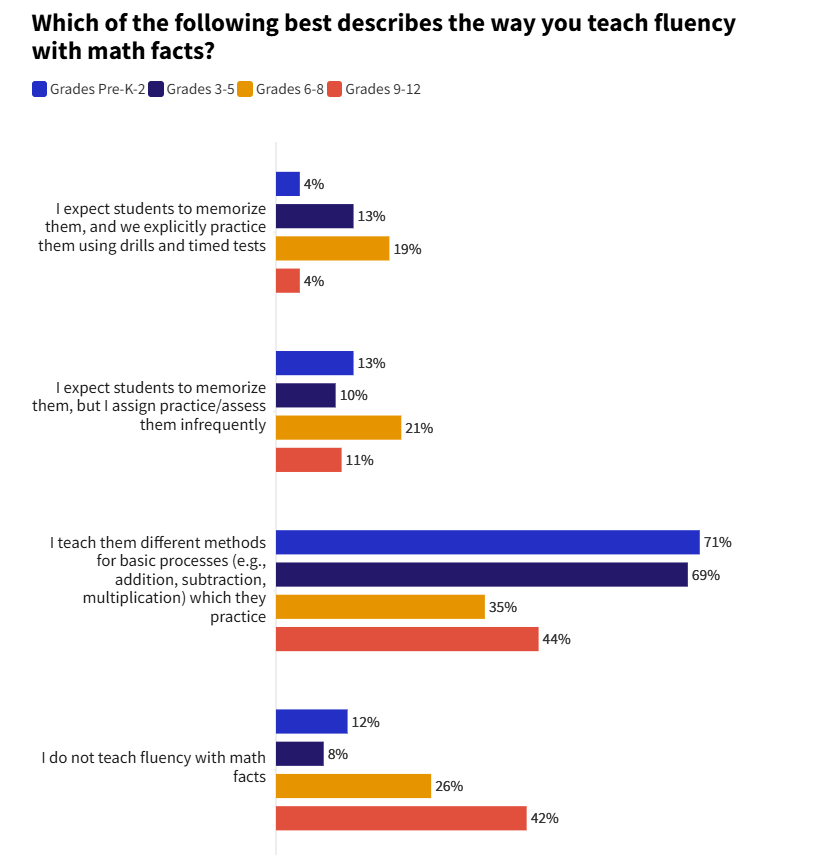
On that same survey though, EdWeek asked teachers how they taught math facts. The dominant response—just practicing the operations over and over again, hoping that they stick—matches my impression of what’s most common in classrooms. It’s unlikely to work for many kids.
Back when I started teaching 3rd and 4th Graders, I had students practice things like 3 x 6 and 8 x 7 on paper a lot, over and over. The theory being, basically, how many times can you do the same thing without remembering it?
Heh. You know the answer, don’t you?
There are paths into New Jersey that I’ve driven a dozen times but could never in a million years recreate. There are two reasons for this. First, New Jersey is a highway hellscape and its exits were designed by psychos. Second, because I never truly rely on memory when we drive—I have Google Maps feeding me each step just in time.
In math also, kids likewise have alternatives to remembering. They can calculate. To learn facts by heart, we have to get students to rely more on their memory. (That’s why “practicing different methods of calculation” is unlikely to work.1) But how do you engineer a situation where students want to rely on memory, even though they’re (currently) bad at that?
“Oh, have you tried flashcards for this?” Yes, I have. I’ve spent a decade trying to make them work. But guess what—I’ve had it! Kids are constantly losing the decks or leaving them places. They also turn over the cards too quickly or (more often) too slowly. Plus, we need all these routines to handle situations where kids don’t immediately remember a fact: “Check the answer…say it aloud…place it next in your pile, then if you get that right…”
Thankfully, I finally have a sturdier routine, one that has uniform expectations that kids can more easily follow:
Study the Facts: If kids are going to practice retrieving a fact from memory, the facts need to be in their memory. That’s our first priority.
Whole-Group Practice: If we don’t practice remembering those facts right away, they’ll end up forgotten. Plus, I want to set the expectation that right now we should be answering these based on memory, rather than reasoning them out.
Individual Quizzing: Not a “quiz” quiz; just a low-stakes chance to practice remembering this stuff on your own.
Here’s what this could look like in detail.
Study the Facts
The curriculum Math Expressions makes these wonderful study sheets for math facts. They are intended for individual use. “To practice,” they write, “students can cover the products with a pencil or a strip of heavy paper. They will say the multiplications, sliding the pencil or paper down the column to see each product after saying it.”2
I tried to repurpose this for the whole group facing the board.
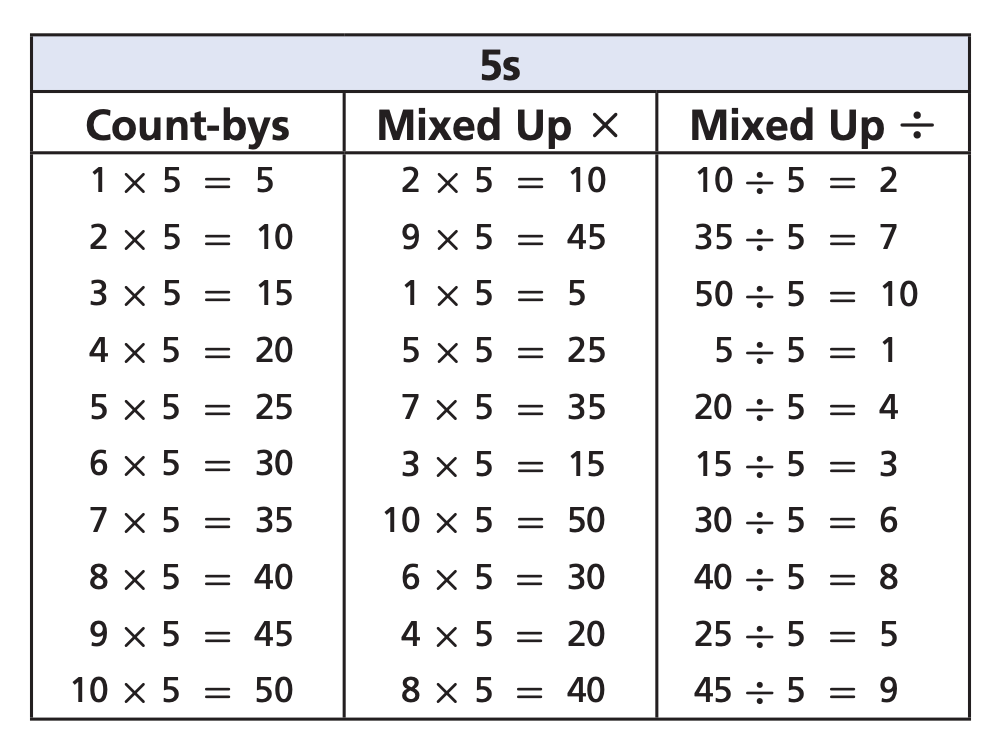
“I’ll say the multiplication, and you’ll say the product right back. One times five is…” We’ll go through that first column once. If you want a challenge, try not to look at the board.
Then sometimes I’ll launch a little discussion.
“What are some things you notice about the fives?” Students might mention regularities in the tens digits or that the ones digit toggles between 5 and 0. They might mention that half of 8 is 4, half of 6 is 3, and so on. There might be good math here, but I’m really just trying to keep attention on these facts a little bit longer.
There are other ways you might focus attention on these facts. You might have a more extensive choral shpiel. You might hand out this study sheet and ask students to do the Math Expressions thing — study each column, cover it with a finger or a pencil, then quiz themselves until it’s perfect.
My flashcard routines were missing this step, instead moving directly to quizzing without any studying first. That was definitely a mistake, but now I’ve fixed it.
Whole-Group Practice
If we don’t practice things right away, we often don’t remember them. One of my goals here is to give everyone a little quizzing before the memories fade. But it’s not just that—I’m also trying to set an expectation.
“We’re trying to know these by heart. I’ll show you waht I mean. Everyone, what’s 2 + 2?” Everyone shouts out 4, immediately. “OK, but what’s 14 + 9?” The response there is slower. We’re trying to learn single-digit multiplication by heart, the same way we know 2 + 2.
“Let’s see how much we remember,” moving the study sheet off the board. “Anybody willing to get put on the spot? Toby, thanks for being brave. Let’s see how much you remember.”
I ask for volunteers because I want to put on some time pressure, and they’re going to get some wrong. “Toby, what’s 5 times 5?” He answers, I give feedback. “25, good. Now, what’s 7 times 5? No, not 45. It’s 35.” I’ll loop back to questions, to show how learning and practice works. “That’s right, 2 x 5 is 10. Now let’s go back to this one. 7 x 5 is…?”
“Give yourself a pat on the back,” I’ll say to Toby. “Anyone else want to give this a shot?”
There are other ways you might do things at this stage. You might try whole-group, choral quizzing, where you basically do flashcard practice with everybody responding. You might cover up the products on that study sheet and call on students to complete them. I can imagine a lot of things working as long as there’s fast-moving practice involved.
Individual Quizzing
Everything up till now has been to make this individual practice useful. “Go to your seats and answer these questions. Let’s see how well you remember what we studied.”
But what if they don’t remember? Well, they still have the study sheets. “You can definitely check your study sheet if you can’t remember an answer. But try to check it as few times as possible, and keep it face down until you need it.” (Of course, I’m circulating the room, keeping an eye on everything.)
This whole thing takes 10-20 minutes.
**
Flashcards are a technology for individual practice. Their whole point is to be customizable and responsive to a single person’s needs.
Teaching a group is hard, so there’s a tendency to retreat to what works for individuals. Give everyone flashcards. Give everyone a computer. Every kid has a tutor. Every kid works on the app. This tendency is maybe especially strong in thinking about math facts, since they’re so heavily studied by special education and psychological researchers who tend to think in terms of individual support—the one-on-one intervention or study. The “Science of Learning” has a bias towards individual pedagogy.
This tendency should be resisted. Teaching a group is most viable when you’re able to teach them as a group. When you treat them as twenty single individuals, each on their own different path, the job also gets twenty times harder. Now, I’m not naive. I understand there are times when the different needs of students are too great for uniform expectations. But I think we’re often too eager to turn a class into a collection of individuals. Instead we can keep class vibrant, interactive, and engaging without asking everyone to retreat to their desks. The collective deserves more respect.
This became clear to me mostly through reading research about fact fluency routines. Shoutout to John Bransford and Ted Hasselbring, whose writing about early math apps in the 1980s I found clarifying.
This mode of practice closely resembles the cluster of fact fluency routines that are common in the world of math interventions. Brian Poncy’s website describes a few of these — Cover, Copy, & Compare, and Taped Problems. I think all these activities basically share the same logic as what I’m doing in this post.
I really enjoyed this. can you elaborate on your "science of learning favours individual" types of teaching comment? it's not something I'd thought much about
I feel like your approach to flashcards here is not wise. At the end of the day, flashcards are just questions (that also happen to be easy to implement, low-stakes and appear at an algorithmically-determined optimal point). But in order to benefit from them, firstly there has to be *some* degree of metacognitive awareness as to the rationale. And secondly, it has to be setup in a way that makes sense.
Asking very young children (!) to use physical (!) flashcards for math (!) whilst in the classroom (!) is not going to be very effective or efficient. I'm struggling to think how this would even look in practice.
Even despite of all this though, I'd still wager that if you were to hypothetically split the class up into 2, after a sufficient period of time, the flashcard group would have made better progress - as determined by grades on some kind of test etc.