
Alpha School is Built Different
Another part of their "secret sauce"

I just watched like three dozen promotional videos from Alpha School. I saw young kids fencing, knitting, rock climbing, biking, jogging, petting a horse, talking to Dr. Phil, golfing, painting, training with Navy SEALs, playing piano, playing guitar, doing pullups, squatting, giving TED talks, kayaking, lighting stuff on fire, baking, running in a parking lot, and recording a podcast. But I struggled to find footage of a student reading a book.
Listen: I promise that this isn’t a takedown. I just want to make an observation.
Alpha is a network of techy private schools that uses a bundle of apps to deliver core academic instruction. They are all over the news, largely fueled by boasts of using AI to teach efficiently. This is the “2 Hour Learning” promise: that math, reading, writing, and science instruction can happen in a tight two-hour window that leaves the afternoon wide open for fencing, knitting, rock climbing, biking, jogging, petting a horse, and so on.
As Dylan Kane notes, the AI claims are a distraction. Up until recently Alpha had been using iXL—a very popular and aggressively mediocre piece of software—to provide all math instruction. They were also using Khan Academy for science. But Alpha and Dylan agree that these apps aren’t the “secret sauce”—the key is Alpha’s motivational scheme, which monitors behavior and incentivizes students to hit their goals on the apps, and especially their new app “Timeback,” which orchestrates this learning.
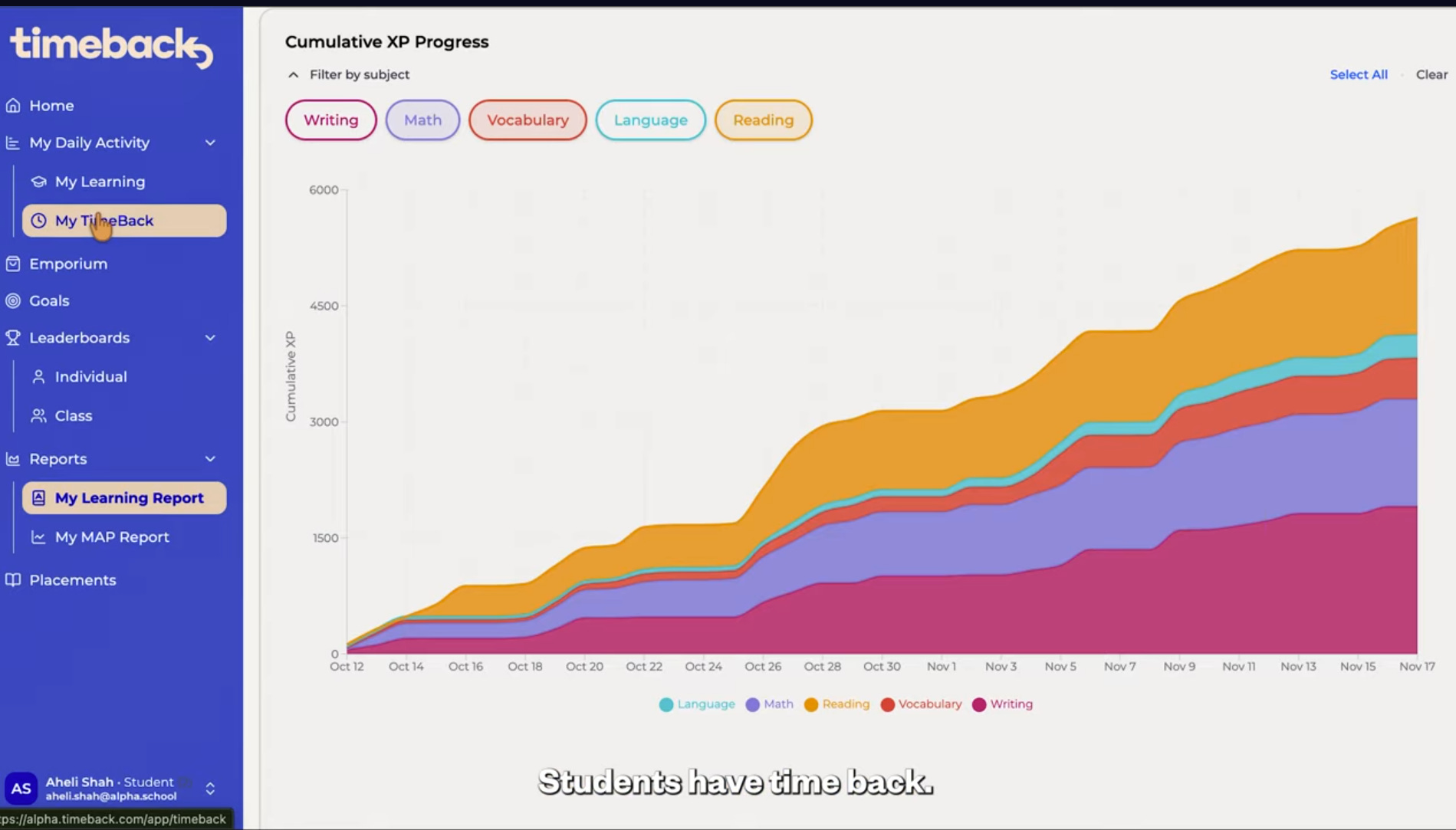
Joe Liemandt, the software billionaire behind Alpha, is incredibly enthusiastic about Timeback. “The single best product I’ve ever built, in four decades, by far,” he says. The premise is literally that, thanks to the efficiency of the learning and their own focused efforts with personalized learning, kids get their time back. Time back for what? For biking, jogging, petting a horse, etc.
(“Joe Liemandt was good at school, and also hated it,” a profile reports.)
Alpha is such a juicy, provocative topic with so many angles: we could dig into their data to see if it matches the hype; there are questions about digital surveillance and privacy; they pay kids to do lessons; it’s an expensive private school; it’s run by a for-profit organization; they’ve rebranded teachers as “guides”; they’re hiring a cadre of learning scientists to redesign their apps; Linda McMahon is a fan; so is Bill Ackman.
But listen, all I want to do is state the obvious: Alpha is not trying to provide the best, most ambitious math or ELA education possible according to conventional understandings of that term. If they were, they’d keep studying ELA/math in the afternoon. Instead, their goal is to minimize the time spent on core academics while maximizing skills.
This is unusual! This is not what most schools are trying to do!
Take Trinity, one of Manhattan’s fanciest schools. They tell parents that they are aiming to foster a “love for literature” in their 3rd Graders. Their texts are “primarily novels and biographies” and “chosen for their literary merit.” They say students will write personal narratives and persuasive essays. There is mandatory independent reading time and also group read-alouds. I have no idea what this looks like in the classroom—but this is what they talk about.
Alpha, on the other hand, has very different aims. Through their AlphaReads software, they assign relatively short AI-generated passages with comprehension questions, similar to those that appear on standardized exams. The texts are primarily historical, scientific, or classical: “Odysseus Returns to Ithaca,” “The Golden Age of Athens,” “Light: How It Bounces and Gets Absorbed.”
Books, as noted, are not at the core—Liemandt says they read in the afternoon, but I can’t tell if this is a daily structured activity, or just something kids sometimes do.
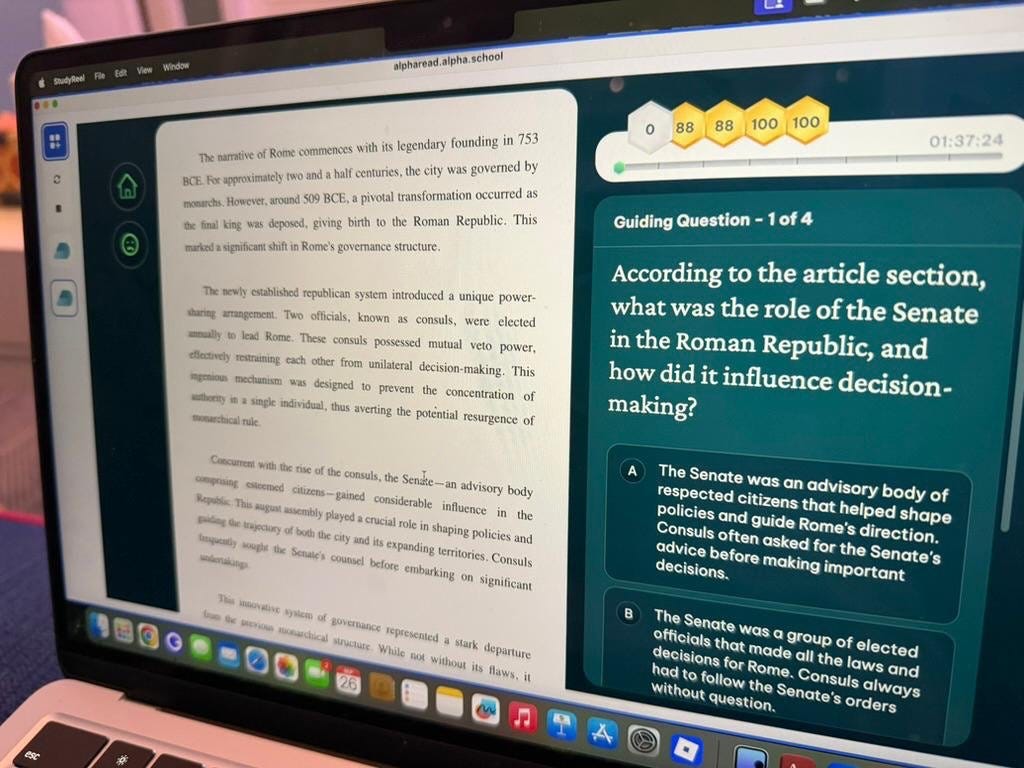
The texts are not human-authored. Alpha is increasing their use of AI-generated texts and questions. A recent 404 Media report had former employees speaking to how bumpy this could be for students as they roll these tools out through Timeback. My point here is simply—you can’t imagine Trinity doing this! This is not what core reading instruction looks like if you’re even talking about fostering a love for literature. Alpha’s goals are simply different than Trinity’s.
Alpha claims that their students are making extraordinary progress on NWEA’s MAP exam. This is not a takedown, I’m not going to evaluate those claims, but here’s the thing—if they are making incredible growth on MAP, that might make sense, because most fancy schools aren’t trying to do that! Most schools, once students clear a certain threshold, try to expand out beyond basic skills. They’ll do a poetry unit. They’ll have kids write their own myths. A librarian will help them find a book that they might fall in love with. Alpha is unusually ambitious in one sense and unusually unambitious in another. They want to focus on skills as measured by MAP. That is of course their right—it’s certainly interesting—but it should also color our understanding of their results.
It’s the same with math. Alpha is in the process of phasing out iXL—404 Media reports that they were scraping iXL and broke the terms of service—and moving all students over to Math Academy. You know what I think about Math Academy: that they’ve narrowed the curriculum to facilitate quick movement through it. My piece on MA was admittedy a takedown—but I’m not doing a takedown here! So let me just point out that the people around Math Academy are very explicit and clear about the tool they have built and its purpose. Its creators talk frequently of “upskilling” the importance of “full-ass effort” and the “grind” of skill development. It is a tool, like AlphaRead, for mastering necessary skills in the least amount of time possible.
This is not how most people who are ambitious and serious about math education talk! My colleagues don’t talk like that. This is an unusual goal to have! If Math Academy succeeds at accelerating strong students quickly so they can rapidly move through a lattice of skills, that might make sense—very few people are trying to do this!
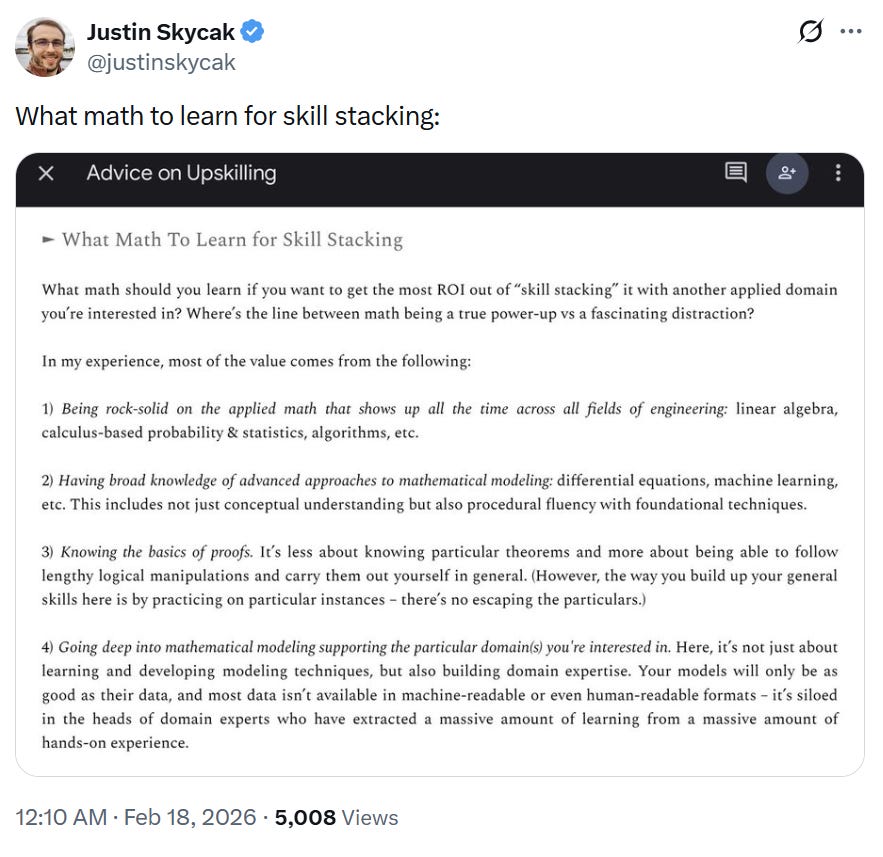
What’s most novel about Alpha School and Math Academy is their fundamental orientation towards K-12 schooling. The goal, quite expressly, is to minimize it and move on. Move on to what? For Math Academy it’s Differential Equations and Machine Learning. For Alpha School it’s life skills like “Grit” and “Entrepreneurship” which are inculcated by biking, jogging, and—to tease just a little bit—petting a horse.
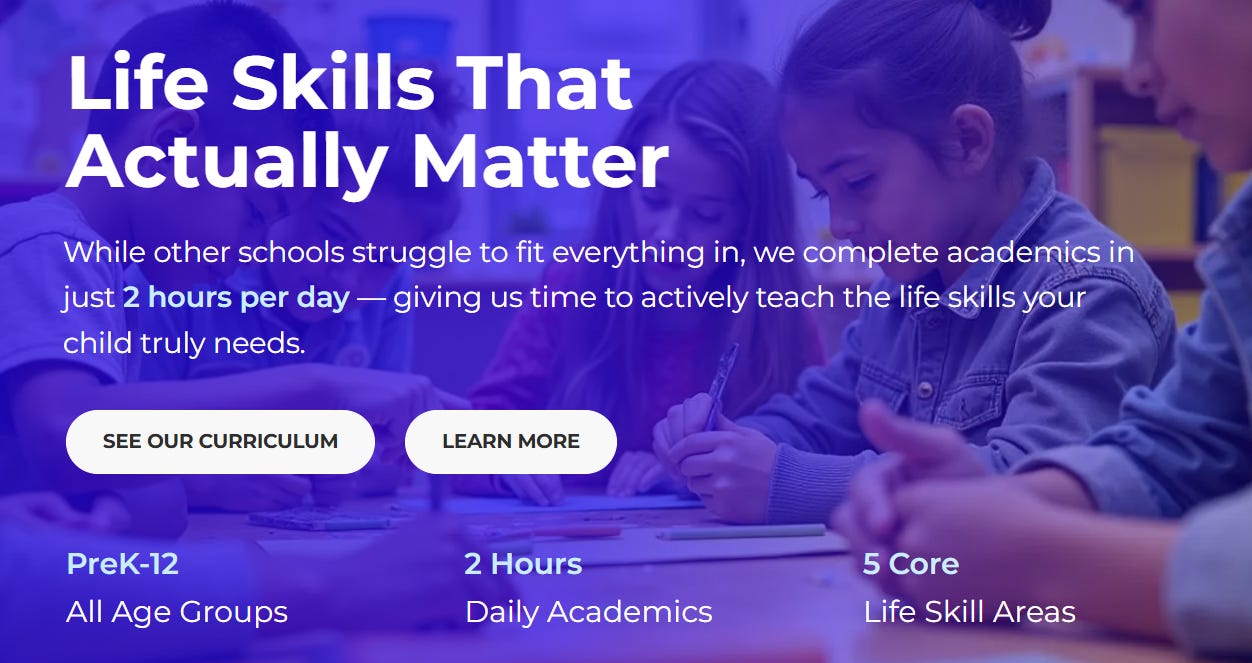
I keep coming around to this: the interesting innovation of Alpha School is not their apps or schedule or Timeback but their relationship to core academics. This is a school that believes that the “core” of schooling should be taken care of as quickly and painlessly as possible so that the rest of the day can be opened up to things that actually matter. Most schools don’t do this! We instead tell kids that history is a way of understanding ourselves and others. Math, we say, can be an absolute joy, full of logical surprises. We tell kids that a good story can open up your heart and mind.
Alpha doesn’t. They aim to streamline and focus on the essentials for skill mastery. Maybe what they’re showing is you can learn to comprehend challenging texts without reading books. Maybe a math education composed of examples and (mostly) multiple choice questions is, in reality, all you need to ace the SAT.
If it turns out they’re succeeding at this, it’s because they’re trying.
And maybe, one day, Alpha or someone else will crack the code for good. It then will be possible to get all students to grind through the skills and move on. With all that extra time, schools will find better things for kids to do than academics. And maybe, at some point, we’ll ask, what’s the point of grinding through things we don’t care about? Do we really need to become great at mathematics when machines can do it? How important is it really to learn how to read novels or fiction? Maybe, one day, this is how books disappear from schools for good.
But that’s just an intrusive thought I keep having, not something I’d put at Alpha’s feet. I’m simply saying this: When you’re trying to figure out whether an educational program is succeeding, look at what they’re trying to do. Alpha is trying to give students their time back from academics. Their curriculum and program reflect that aim. This is worth keeping in mind.
I dislike the "crush academics and move on" messaging Alpha's marketing tends to have.
But I also think it's impossible to reach a goal of kids "loving math" or "loving reading" if you don't actually help them develop rigorous skills in those realms. Whatever lofty goal conventional education claims to have re: love and curiosity, the vast majority of kids *don't* achieve that goal—in large part because they don't develop basic, let alone rigorous, skills in anything. Most kids emphatically do not love school, love learning, or love any of the subjects where curiosity is allegedly being fostered.
Assuming the kids at Alpha are actually "crushing" the core skills they're being taught, the students are at least meeting the essential precondition for coming to love any subject.
Programs like IXL focus on particular math skills at a low depth of knowledge. I think math skills are important, and programs like IXL have their place, but low DOK skills are insufficient by themselves.
I'm cranky that their website now claims that they are a "comprehensive math curriculum", when they used to say that IXL is a "supplement to good quality instruction". IXL isn't a complete curriculum any more than Khan Academy is. This is harmful to students when a teacher decides to put all their kids on the computer for 40 minutes a day -- as if non-social disconnected computer lessons are an effective replacement for all of the things students learn from working together with humans. Teachers might even think this is superior because students who aren't allowed to work together "misbehave less" and because each student gets an "adaptive experience" tailored to their skill "deficits".
I'm also cranky that their dashboards make claims about what students know in a seemingly "comprehensive" way, as if measuring low DOK skills alone is sufficient to give a full picture of a students academic progress in math. Schools use these reports as the "one source of truth" in a way that is harmful to students -- for example, when they see a 5th grade student "at a 3rd grade math level" and conclude that this student should really only be doing 3rd grade math.